
Getting pregnant is not always as simple as we were taught in school. Remember how the teacher stood at the front of the class with a serious face, telling us that every act of intercourse would definitely lead to pregnancy — and then handed out condoms in every direction? In reality, life has a few complications. In Estonia, approximately 15–20% of couples experience fertility problems, meaning that when a baby is desired, medical intervention is needed.
Fertility treatment is physically and mentally intense. Every IVF cycle, every blood test and all the waiting and hoping can feel exhausting. On top of that, as we age, the number and quality of eggs begins to decline, which adds its own pressures. But it is worth remembering: science has advanced further than any of us could have imagined. IVF itself is a truly wonderful option, and modern embryo diagnostics for eliminating genetic diseases — really — a small scientific miracle that helps select the strongest and healthiest embryos.
Mis on baroteraapia (HBOT) ja kuidas see töötab?
HBOT(hyperbaric oxygen therapy)may sound a little… cosmic at first glance. In reality, the point of it is quite simple. You breathe pure oxygen under pressure in a specialised chamber, which helps deliver significantly more oxygen to the body than under normal conditions. It does not stay only in the blood — it reaches deeper into the tissues, including places where oxygen might otherwise find it more difficult to reach. Point is actually quite simple. You breathe pure oxygen under pressure in a specialised chamber, which helps deliver significantly more oxygen to the body than under normal conditions. It does not stay only in the blood — it reaches deeper into the tissues, including places where oxygen might otherwise find it more difficult to reach. 🙂
Every cell in our body needs oxygen to function. This includes the ovaries and the developing eggs. When our cells and tissues receive more oxygen, their blood supply and the environment in which eggs mature improves. This can support both the development of eggs and their quality — the small but very important details on which IVF success often depends.
Kellele võib baroteraapia viljatusravi ajal sobida?
Baroteraapiat (HBOT-i) ja IVFi koosmõju pole eriti uuritud. Küll aga leidsin ma IVF-i ja hapnikuteraapia kohta ühe väga huvipakkuva uuringu ↓ aastast 2025, mis on tõeliselt innovaatiline ja lootustandev.
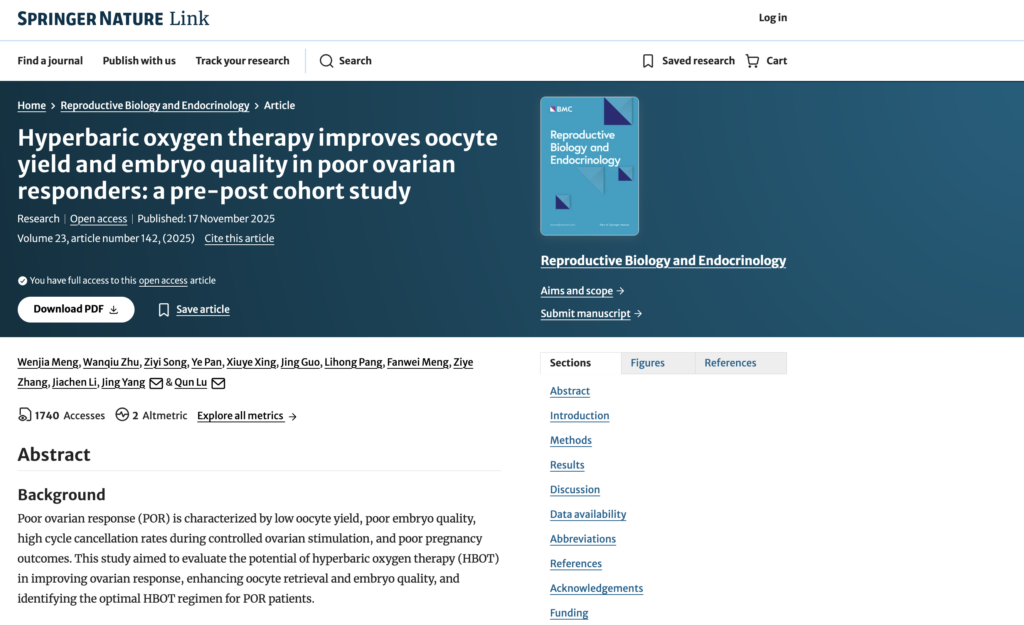
Figure 1. Article on supporting IVF with hyperbaric oxygen therapy. Available here. here.
The study examined 41 women aged 20–45 who, in addition to IVF treatment, used hyperbaric therapy to support their health. Their results were compared before and after hyperbaric therapy. The women in the study underwent hyperbaric therapy during the IVF cycle, with therapy beginning on the third day of menstruation — precisely when follicles are growing and eggs are maturing, and when they need most:
— oxygen;
— nutrients;
— good blood supply.
Hyperbaric therapy was carried out either daily or every other day. The therapy lasted 120 minutes, of which 60 minutes involved breathing pure oxygen under pressure.
Over half of the women (56%) were aged 40 and above. The majority had multiple previous unsuccessful fertility treatment cycles. Many of the participants had very low ovarian reserve.
This was a high-risk group in which improving outcomes is typically difficult. Particularly interesting was the fact that before hyperbaric therapy, many of the women had produced no embryos at all.
Can hyperbaric oxygen therapy (HBOT) improve IVF outcomes?
The results of the above study were remarkable:
- the number of eggs increased
- ovarian response to stimulation improved
- the rate of successful fertilisation rose
- the number of high-quality embryos increased
While I usually recommend a course of 10–30 hyperbaric therapy sessions, what was interesting about this study was that approximately 4–7 sessions appeared to be the number at which results were best.
The reason why IVF success rates increased may lie in improved blood supply and oxygen availability, which promotes follicle development, reduces oxidative stress and supports cellular energy metabolism.
Hyperbaric therapy does not replace fertility treatment, but may be a valuable supplementary method — particularly for women for whom several consecutive IVF cycles have not succeeded for one reason or another.
The fertility treatment and hyperbaric therapy study suggests that HBOT may:
- promote the formation of new blood vessels (better blood supply to the ovaries)
- improve cellular energy metabolism
- reduce oxidative stress, which damages eggs
- support egg maturation and embryo development
Note: This is a summary of one study nd does not guarantee that hyperbaric therapy will definitely help. What matters to me is raising public awareness of options where hyperbaric therapy may — but may not — help.
Leave a Reply